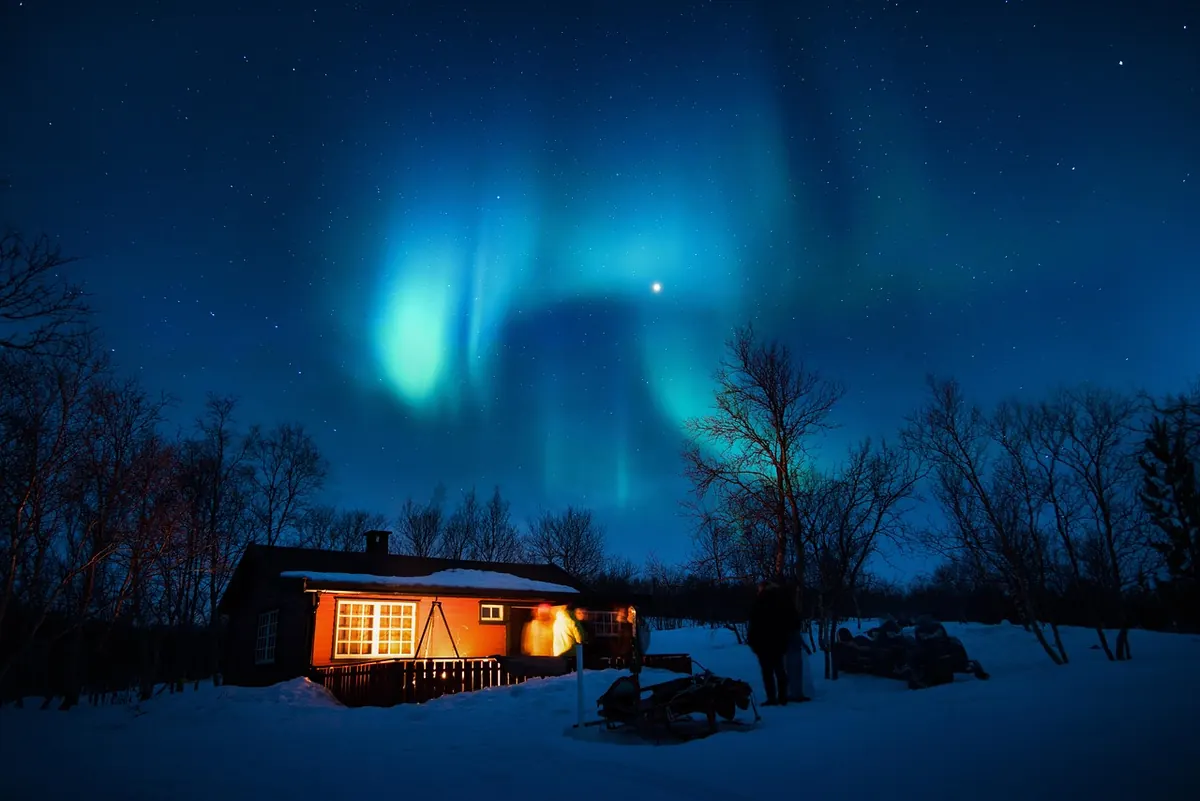
The first aurora you see from a British hillside rarely looks like the photographs. It usually begins as a pale grey arc low in the north, easy to mistake for cloud or the glow of a distant town. Then it shifts: a column brightens, folds over, fades, returns. Ten minutes later the whole northern sky has a green tinge and you have stopped noticing the cold. Knowing what you are looking at, and when it is likely to appear, turns a lucky accident into something you can plan for.
What actually causes the northern lights
The Sun is not a quiet object. It constantly throws out a stream of charged particles — the solar wind — and every so often launches a denser burst in what is called a coronal mass ejection. When that material reaches Earth, most of it is deflected by the planet's magnetic field. Some of it, though, is funnelled down towards the poles, where the particles collide with oxygen and nitrogen atoms roughly 100 to 300 kilometres above the ground.
Those collisions knock electrons into higher energy states, and as the atoms settle back they release light. Oxygen at lower altitudes gives the familiar green; oxygen higher up produces deep red; nitrogen adds purple and blue fringes. The result is a ring of light around each magnetic pole, known as the auroral oval — and it is the southern edge of that oval that British skywatchers are chasing.
Why the UK gets a look-in at all
Britain is not in the Arctic, but it is close enough for the oval to reach us when the geomagnetic field is disturbed. Shetland, Orkney and the far north of Scotland sit nearest to the oval and see displays many times a year, often without anyone noticing. From northern England, Northern Ireland and north Wales you need a decent storm. From the Midlands southwards, you need a big one — and a great deal of luck with cloud.
The Kp index, a three-hourly measure of global geomagnetic disturbance, is the number people quote, and it is a rough guide at best:
- Kp 5: possible from northern Scotland, particularly the north coast and islands.
- Kp 6 to 7: northern England, Northern Ireland, north Wales and the Scottish borders come into play.
- Kp 8 and above: a chance from southern England, usually as a glow or faint pillars low on the northern horizon rather than an overhead display.
Treat those as guidance, not rules. Where you stand matters as much as the number: a dark site with an open northern horizon in Yorkshire can beat a cloud-covered glen in Sutherland.
When to look, and when to give up
UK aurora season runs roughly from September to March, when there is enough astronomical darkness. Displays are often reported around the equinoxes in March and September, though the reasons for that pattern are still debated.
Most sightings happen between about 10pm and 2am, so an evening that looks dead at half nine is not necessarily over. Activity rarely arrives as a steady glow; it comes in bursts called substorms, each lasting perhaps twenty minutes to half an hour, with quiet gaps between. If you see nothing at midnight, another look at one in the morning is not wasted effort.
Three practical factors decide whether a promising forecast turns into a memory:
- Cloud. The single biggest killer. A Kp 8 storm behind cloud is worth nothing at all.
- The Moon. A bright Moon washes out faint aurora, so a new-Moon window is ideal — but a strong display will still cut through moonlight.
- Light pollution. Town glow hides the faint arcs that appear before a display brightens.
Where to go for a dark northern horizon
You do not need to drive to the Highlands. You need somewhere dark, with nothing tall to the north and as little artificial light as possible. In practice, that means getting out of town by twenty minutes or more and finding a quiet lane, a hilltop lay-by or a dark beach.
- Scotland: Galloway Forest Dark Sky Park, the Cairngorms, the coast of Caithness and Sutherland, Orkney, Shetland, the Outer Hebrides.
- Northern England: Kielder Forest and the Northumberland coast, the North York Moors, the Lake District, the Yorkshire Dales.
- Northern Ireland and Wales: the Causeway Coast and the Sperrins; Anglesey, the Llŷn Peninsula and the darker parts of Snowdonia.
- Further south: Exmoor, Bodmin Moor, the South Downs and the north Norfolk coast all have usable dark skies — they simply need a bigger storm.
Once you are there, look north and low. Aurora almost always starts near the horizon and climbs; it is nothing like the overhead curtains in the postcards.
A clear sky matters more than a large Kp number. Check the cloud forecast before you check the space weather.
Reading the forecasts without losing your mind
Space weather forecasting is genuinely difficult, and short-notice changes are normal. The useful habit is to check a handful of things in order, and to accept that a forecast is a probability rather than a promise.
- Space weather. The US National Oceanic and Atmospheric Administration publishes a three-day Kp forecast, and sites such as Space Weather Live show current conditions. Look at the solar wind speed, the density and above all the direction of the magnetic field, given as Bz: a sustained southward (negative) Bz couples energy into our magnetic field and is a good sign.
- Local alerts. AuroraWatch UK, run from Lancaster University, sends free alerts based on magnetometer readings in Britain. A rising trace is often the earliest hint that something is happening overhead.
- Cloud. Satellite imagery and a decent hourly cloud forecast matter more than anything else. Learn to read the movement of cloud on the satellite loop rather than trusting a symbol.
- Your own eyes. Get outside and let your eyes adapt for twenty minutes. A faint grey band that brightens when you look slightly away from it is probably the aurora.
Photographing what you can barely see
Cameras collect far more light than your eyes do, which is why a greenish smudge becomes a vivid photograph. With an interchangeable-lens camera, use a tripod, manual mode, a wide lens opened as far as it will go, ISO 1600 to 3200, and exposures of about five to fifteen seconds. Focus manually on a bright star using magnified live view, and shoot in RAW so you can adjust the colour balance later — the camera will often record a greenish cast as grey.
Phone cameras can produce perfectly respectable aurora shots. Use night mode, brace the phone against something solid or use a small tripod, disable the flash, and expect to experiment with exposure times of a few seconds. Cold drains batteries quickly, so carry a spare and keep it warm in an inside pocket.
Your aurora night, in short
Check space weather first, then cloud, and only then decide to go. Pick a dark spot with a clear northern horizon within reasonable driving distance, and give yourself until at least one in the morning. Dress for a temperature several degrees colder than the forecast, take a flask and a red-light torch to protect your night vision, and tell someone where you are going and when you expect to be back. Park legally and safely, avoid walking near cliffs, water or ice in the dark, and remember that most chases end with nothing but stars.
That is not failure. It is how aurora watching works in Britain: you stack the odds, you go out often, and eventually the northern sky rewards you.
Photo: Pexels / Pixabay