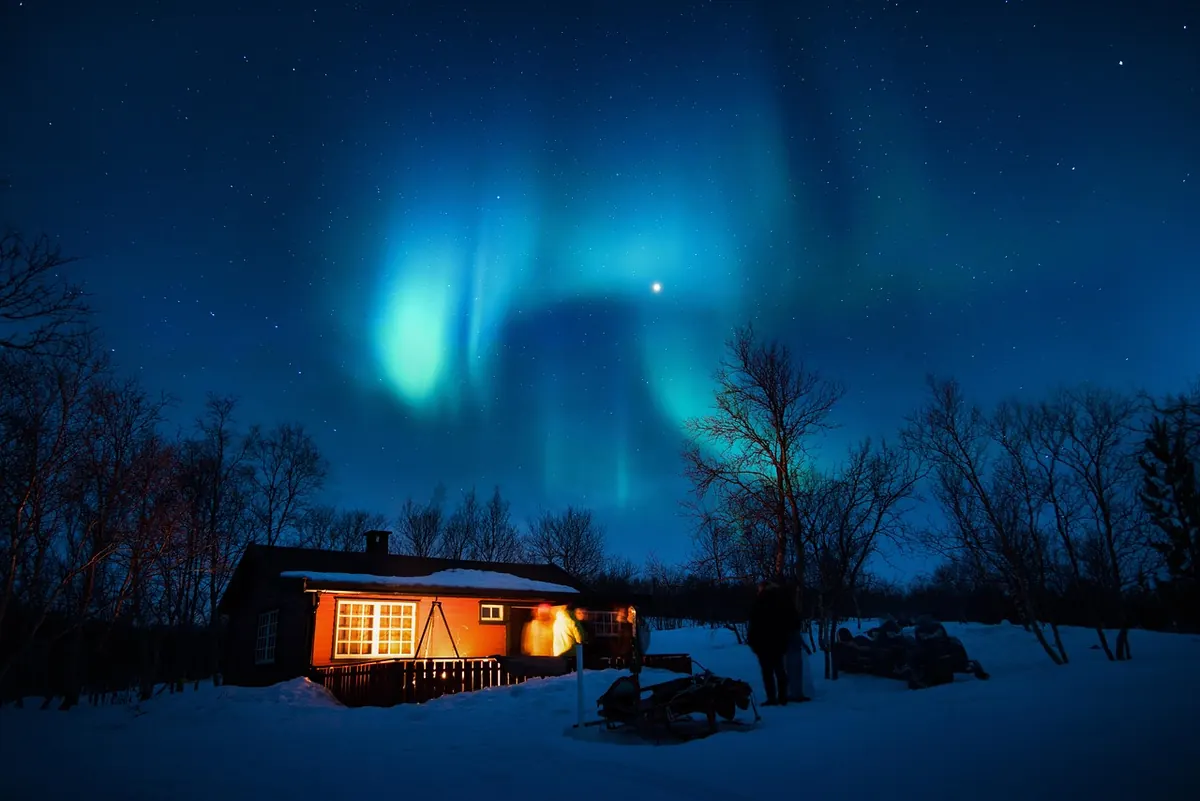
On a clear night in May 2024, people across the UK stood in gardens and on beaches watching pink and green light ripple overhead. Nothing anyone did caused it. A cluster of sunspots had thrown a billion tonnes of charged particles towards us, and for a few hours Britain's skies looked like the Arctic.
That was space weather: the Sun's behaviour, measured in flares, storms and particle showers, and felt here on the ground and in orbit. It is worth understanding, because the same events that paint the sky can drop satellite signals, black out radio and push power grids to their limits.
What we mean by "space weather"
Space weather describes conditions in the space around Earth, driven mostly by the Sun. The main ingredients are solar flares, coronal mass ejections (CMEs), high-speed streams of solar wind and bursts of energetic particles. Forecasters track them much as meteorologists track low-pressure systems: watching the Sun's surface and atmosphere, then modelling how what leaves it will travel.
Unlike terrestrial weather, there is little anyone can do to prepare beyond knowing what is coming. But knowing matters. Airlines reroute polar flights, satellite operators delay manoeuvres, grid engineers watch their networks and aurora hunters charge their cameras — all on the strength of a forecast that something left the Sun a day or two ago.
The Sun's two main hazards
Solar flares
A solar flare is an abrupt release of magnetic energy near a sunspot group. It throws out X-rays and extreme ultraviolet light, which travel at the speed of light and reach Earth in about eight minutes. The immediate effect is on the dayside ionosphere: high-frequency radio signals that would normally bounce off it can fade or vanish, which matters for aviation, shipping and amateur radio. Most flares are over in minutes to hours.
Coronal mass ejections
A CME is slower and heavier — a cloud of plasma carrying its own magnetic field. Travel time varies from roughly fifteen hours to a few days. Not every CME hits Earth; some miss entirely, and some arrive with a magnetic field pointing the wrong way to cause much trouble. When a well-aimed CME arrives with a southward-pointing field, it can couple with Earth's magnetosphere and trigger a geomagnetic storm.
How a storm unfolds
- Magnetic energy builds in a sunspot group and releases as a flare.
- Radiation arrives within minutes; dayside radio may fade.
- A CME, if launched towards us, crosses the gap in fifteen hours to three days.
- The solar wind shock compresses Earth's magnetic field.
- Charged particles funnel towards the poles and a geomagnetic storm develops.
- Effects fade over hours or days as the disturbance passes.
Storms are graded from G1 (minor) to G5 (extreme). Most are G1 or G2 and pass with little notice. From G3 upwards the effects start to be felt: aurora moves further south, satellite drag rises and navigation signals wobble.
What happens to satellites
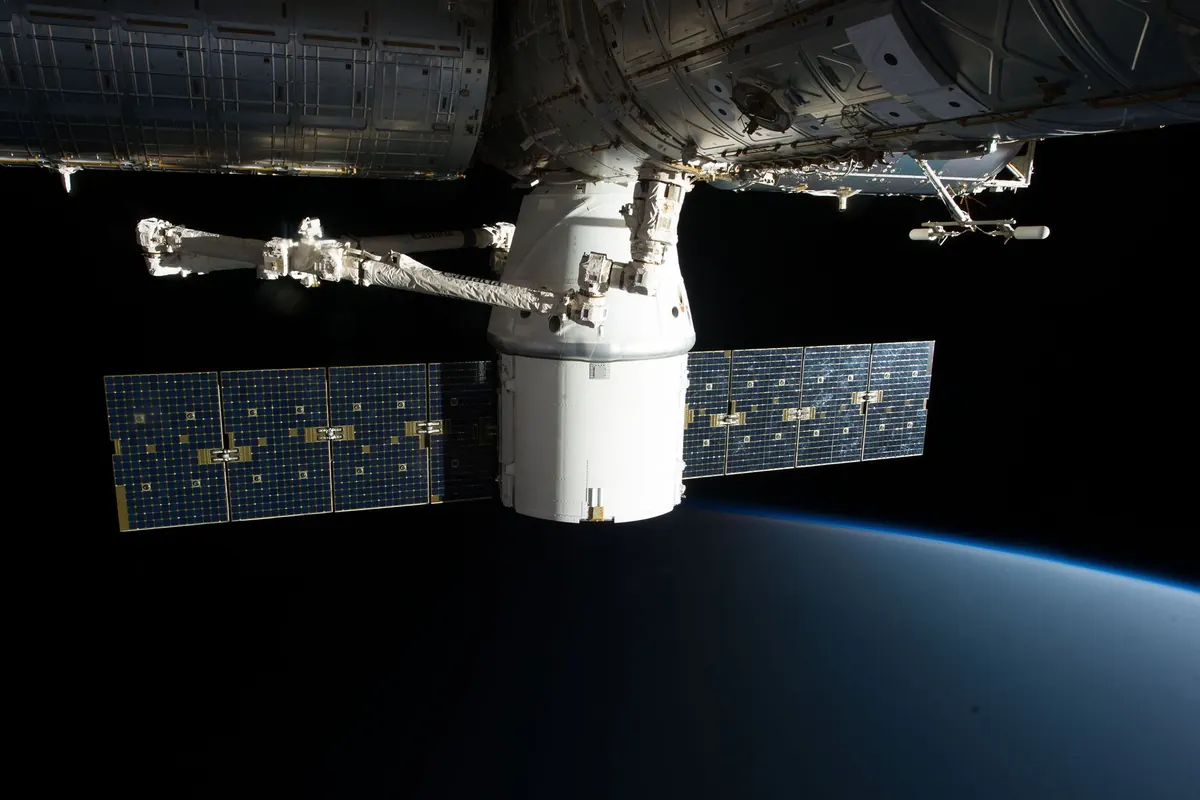
Spacecraft feel a storm in several ways at once.
- Drag. The thermosphere heats and expands, so the air thickens at the altitudes where many satellites orbit. They slow down, and operators burn fuel to hold their orbits. A modest storm in 2022 was enough to bring down a batch of small satellites whose thrusters could not out-climb the extra drag.
- Charging. Energetic particles build static on surfaces and inside components, and sudden discharges can damage electronics or corrupt data.
- Radiation. Long-term exposure degrades solar panels and sensors, and can flip bits in memory.
- Signals. The ionosphere becomes uneven, which weakens GPS and other navigation services and disrupts the radio links used by ships and aircraft.
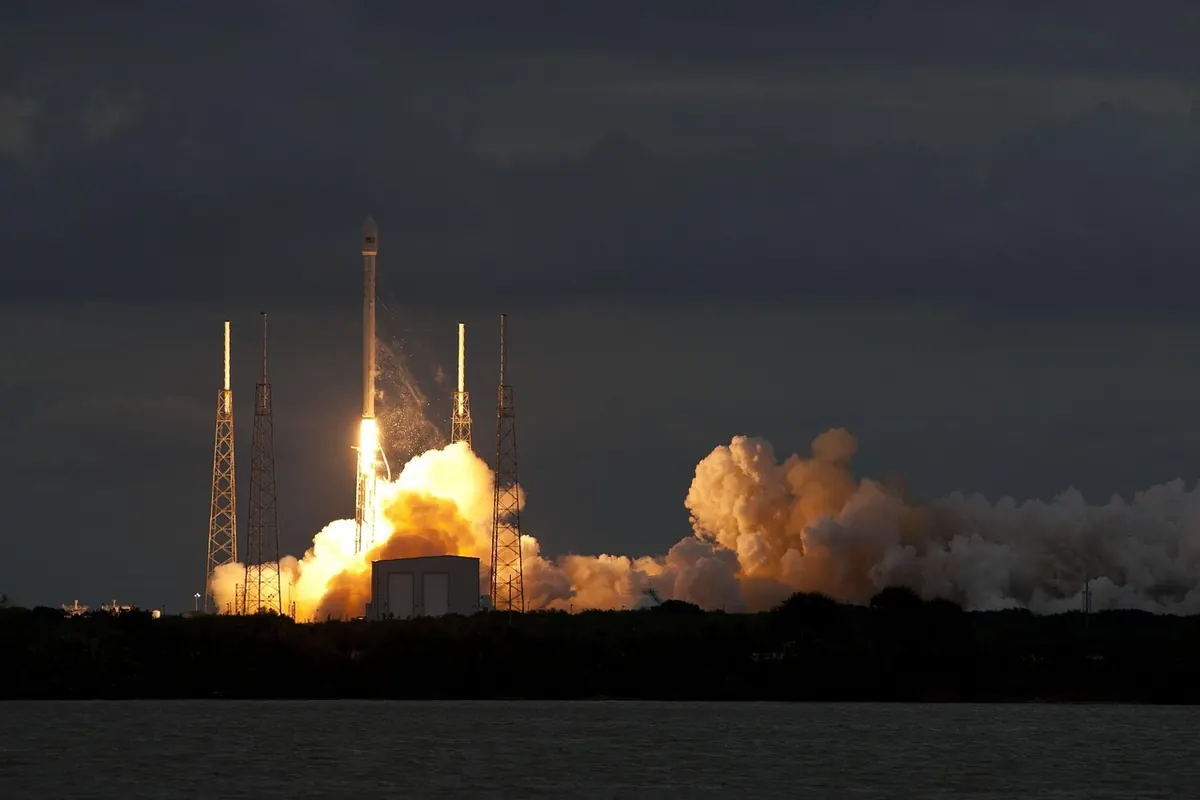
Standard practice is to put sensitive spacecraft into safe mode, postpone orbit changes and delay launches until the disturbance has passed.
Why the aurora reaches Britain
Aurora forms when charged particles from the solar wind are funnelled along Earth's magnetic field lines towards the poles, colliding with oxygen and nitrogen high in the atmosphere. Green light comes from oxygen at around 100–150 kilometres up; the reds and pinks come from higher, thinner oxygen and are the colours most often captured by cameras over the UK.
What matters is geomagnetic latitude, which runs lower than geographic latitude across Britain. In practice, a strong storm can put the auroral oval over Scotland, Northern Ireland and northern England, and a severe one can push visible aurora into southern England — usually as a faint glow rather than a curtain. Cameras pick up colour the eye cannot, which is why a night when you "see nothing" can still produce a striking photograph.
The wider effects on the ground
Geomagnetic storms induce currents in long conductors. Power grids, pipelines and railway signalling can all be affected, which is why grid operators watch forecasts closely and take precautions during large events. There is a well-known precedent: a severe storm in March 1989 left millions of people in Quebec without power for hours.
Aviation feels it too. Polar routes are sometimes rerouted during storms, partly because high-frequency radio — used as a backup for communication over remote regions — can become unreliable. For most people on the ground, though, the practical consequences are mild: a day of patchy satellite navigation, an occasional satellite TV glitch, and a good reason to look up. If your work depends on satellite services, follow the guidance from your equipment supplier and the relevant authority rather than improvising.
How to catch the next aurora
- Check a forecast. AuroraWatch UK, run by Lancaster University, sends free alerts based on geomagnetic activity, and the NOAA space weather centre publishes storm forecasts and Kp values.
- Use Kp as a rough guide. Kp 5 gives Scotland a fighting chance; Kp 7 or above is when southern England gets involved.
- Find dark sky. Get away from streetlights and face north with a clear, low horizon. The coast is often ideal.
- Go later than you think. Activity frequently peaks around local midnight and beyond.
- Let your eyes adapt. Give them twenty minutes without staring at a phone screen, and use red light if you need any.
- Take a photo. A phone on a tripod with a ten-second exposure will reveal colour your eyes miss.
- Be patient and dress for it. Aurora watching is mostly standing around in the cold. Treat it as a night out, not a quick look.
- Watch the solar cycle. Activity rises and falls over roughly eleven years, and the years around maximum bring more chances.
The Sun will keep sending storms our way whether or not we are watching. Learning the basics means you can tell the difference between a quiet week and a night worth putting your boots on for.