The International Space Station is the easiest thing in the night sky to see, and the easiest to miss. It crosses Britain several times a week, but each pass lasts only a few minutes, and it never announces itself. Treat it like a train: know the timetable, stand in the right spot, look up at the right moment, and the whole thing is over in five minutes.
The rest is detail. Here is how to work out when the station is coming over, how to read the numbers in a pass alert, what you are actually looking at, and how to come away with a photograph worth keeping.
Find Pass Times for Your Own Location
Every prediction service works from the same orbital data, so pick whichever suits you and ignore the rest. The differences lie in presentation, not accuracy.
- NASA's Spot the Station sends email or text alerts for a chosen town or city. Set it up once and forget it.
- Heavens-Above gives the most detail: a star chart for each pass, plus magnitude, altitude and direction. The one to use if you are planning photography.
- Apps such as ISS Detector, Sky Guide or Stellarium offer a compass arrow and a countdown, which is what you want when you are standing in a dark garden.
Give the service your real location. A town twenty kilometres away makes almost no difference, but alerts for a city on the other side of the country are useless: the station's track across the sky shifts noticeably with latitude.
How to Read a Pass Alert
A typical alert looks like a wall of numbers. Only five of them matter.
- Start time: when the station rises above the horizon. Be outside two or three minutes early.
- Max altitude: the highest point of the pass, in degrees above the horizon. The horizon is 0°, straight overhead is 90°.
- Duration: usually somewhere between two and seven minutes.
- Appears and disappears: compass directions. “Appears WSW, disappears ENE” tells you which way to face, and roughly where to look first.
- Magnitude: brightness on the astronomers' scale, where lower numbers are brighter. A negative figure such as −3 means a brilliant pass. Anything above 0 will be faint and easy to miss.
Ignore passes that never climb above about 20°. They skim the horizon, sit in the thickest part of the atmosphere, and are usually hidden behind rooftops before they get going.
What Makes One Pass Better Than Another
Sunlight and darkness have to overlap
The station shines only by reflected sunlight. For you to see it, it must be in sunlight while your sky is dark enough, which means roughly the couple of hours after sunset and before sunrise. A pass at two in the morning is usually invisible, because the station is inside Earth's shadow.
British twilight is the real constraint
At UK latitudes the sky stays bright late into summer evenings, which washes out all but the very brightest passes. Midsummer often brings long twilight and few good sightings. Autumn and winter evenings give properly dark skies, and you can get a run of excellent passes around the equinoxes. Late winter and early spring are often the most rewarding months of the year.
Height above the horizon
A pass that climbs to 60° or more is the one to bother with. It stays bright for longer, crosses more of the sky, and gives you far more chance to spot it if your timing is slightly out. Lower passes are still worth a look, but plan them around a clear horizon.
What the Station Actually Looks Like
In practice it is a single steady white point, about as bright as a bright star or a planet, moving smoothly and silently across the sky. It never blinks, never flashes and makes no sound. Aircraft blink, carry coloured navigation lights, and appear to crawl; the station moves at a brisk, constant pace, roughly like a high aircraft but with no strobe.
It usually appears dim near the horizon, brightens as it climbs, then fades. There are two reasons for that fade, and they are worth telling apart: it is either dropping into thicker atmosphere low in the sky, or sliding into Earth's shadow. Binoculars help on a very high pass, where you can occasionally catch the shape of the solar arrays, but tracking something moving that fast by hand is fiddly. A telescope is not much use here.
A pass that fades out while still high overhead has not gone wrong. You have just watched the moment the station enters Earth's shadow.
Photographing the Station
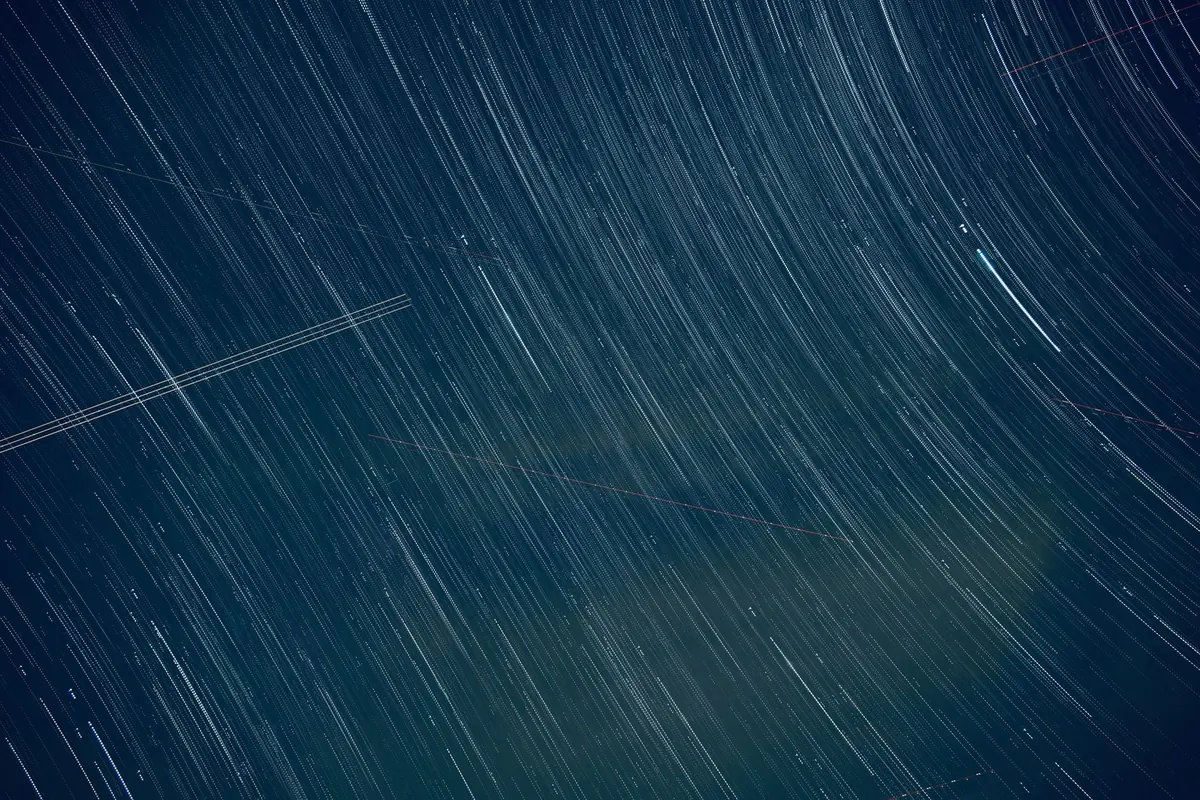
The classic streak shot
- Use a tripod and a wide lens. A wide view gives the pass room to cross the frame, and includes a roofline, tree or chimney for scale.
- Set manual focus to infinity and check it with a test shot on a bright star.
- Start with ISO 400–800 and an aperture of f/2.8 to f/4.
- Take a series of 10–20 second exposures through the pass and stack them afterwards. In a light-polluted town, many short frames combined in free stacking software will beat one long exposure every time.
With a phone
Phones can do this on a bright pass. Put the phone on a tripod or rest it on a wall, switch to night mode or Pro mode, and set an exposure of four to ten seconds. Use the timer so your hand isn't touching the phone when the shutter opens, and keep the foreground simple: a dark skyline, a lamp post, a church tower.
Transits, if you fancy a challenge
Now and then the station crosses the face of the Moon or the Sun, visible from a narrow strip of ground only a few kilometres wide. ISS Transit Finder will work out whether that strip passes near you. For a solar transit, a certified solar filter over the front of the lens is not optional; even a brief unfiltered look at the Sun through optics can cause permanent eye damage. Lunar transits need no filter at all.
Make It a Weekly Habit
Check the timetable once a week, find a pass above 40°, and set an alarm for five minutes before it starts. Step outside, let your eyes adjust, and face the direction given in the alert. If you miss it, no harm done: another one will come round in a day or two. Keep a short log of what you saw, with the date, the brightness and the direction of travel. After a season of that you will start to recognise the geometry for yourself, and you will know within a few seconds of stepping outside whether tonight is going to be a good one.
Photo: Leon Wang / Pexels